Seahorse XF: Immunometabolism & Bioenergetics
- Drug Discovery & Preclinical
- Monoclonal Antibodies
- Antibody-Drug Conjugates
- Vaccines (Prophylactic & Therapeutic)
- Cell & Gene Therapies (CGT)
- Allergy & Hypersensitivity
- Biomarker
- High-Dimensional Single-Cell Analysis by Flow Cytometry
- High-Throughput Cytokine & Chemokine Profiling by Multiplexing
- Biomarkers via Advanced IHC & Spatial Imaging
- Rare Cellular Functional Biomarkers by ELISPOT
- Real-Time Kinetic Biomarkers by IncuCyte S3
- Genomic Biomarker Analysis by qPCR & Droplet Digital PCR
- Seahorse XF: Immunometabolism & Bioenergetics
- MALDI Biotyper: Rapid Microbial & Proteomic Profiling
- Sapidyne KinExA
- Robust Protein Quantification by ELISA
- Advanced LNP Formulation & Screening – Unchained Labs Sunshine
- Translational & Clinical Research
- Immunogenicity Risk Assessment & Immunotoxicology
- Regulated Bioanalysis: PK, PD & Soluble Biomarkers
- Histopathology & Spatial Biology
- Advanced Flow Cytometry & Cellular Immunology
- Molecular Bioanalysis & Genomic Profiling
- Functional Potency & Ex Vivo Translational Models
- Central Laboratory & Clinical Trial Sample Management
- Dermo-Cosmetics & FMCG
- Nutraceuticals & Wellness
- Biorepository
Seahorse XF: Immunometabolism & Bioenergetics
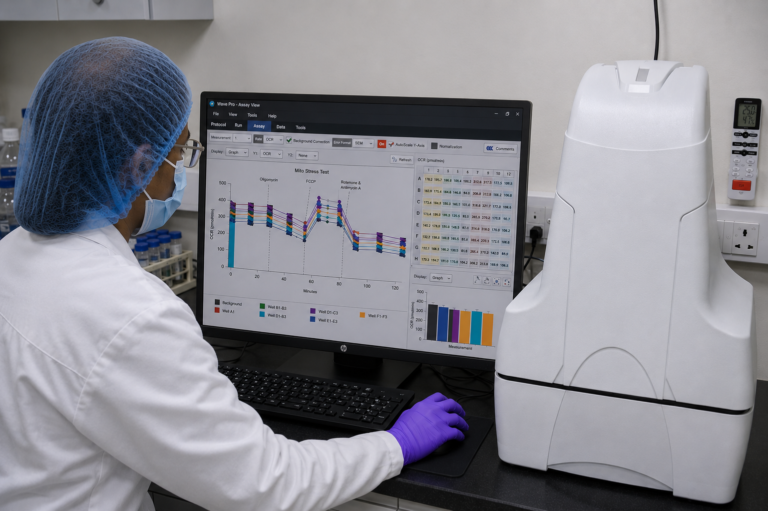
Metabolic reprogramming is a hallmark of many diseases and a critical factor in determining the efficacy of advanced cellular therapies. We utilize Agilent Seahorse XF® technology to provide dynamic, real-time measurements of the two major cellular energy-producing pathways: oxidative phosphorylation and glycolysis. By continuously quantifying the Oxygen Consumption Rate (OCR) and Extracellular Acidification Rate (ECAR) in live cells, we deliver comprehensive metabolic phenotypes that static endpoint assays simply cannot achieve.
Our bespoke assay portfolio supports robust decision-making across the entire drug discovery and development pipeline:
Cellular Metabolic Profiling (OCR & ECAR):
Obtain a complete, label-free picture of cellular energy metabolism by simultaneously tracking oxygen consumption and proton efflux in real-time to establish an accurate baseline metabolic phenotype.
Mitochondrial Function Analysis:
Quantify key parameters of mitochondrial respiration including basal respiration, ATP-linked respiration, proton leak, and spare respiratory capacity utilizing the industry-standard Cell Mito Stress Test.
Glycolysis Stress Testing:
Directly measure the capacity and flexibility of the glycolytic pathway. By driving cells to maximum glycolytic output following glucose starvation, we reveal transient responses critical to cellular survival under physiological stress.
T-cell & CAR-T Metabolic Fitness Assessment:
Evaluate the underlying bioenergetic profiles that drive durable immune responses. We assess the metabolic persistence and fitness of T-cells and engineered CAR-T populations to ensure optimal energy allocation for sustained antitumor activity, even within hostile tumor microenvironments.
Metabolic Toxicity Studies:
Screen therapeutic candidates for off-target mitochondrial liabilities or broader metabolic disruption. Real-time metabolic kinetics provide a highly sensitive, mechanism-specific assessment of drug-induced toxicity prior to advancing into complex preclinical models.